Enterprise Case Study
Controlled Deployments at Scale on Azure AKS
How Arxston unified CI/CD pipelines and enforced feature-controlled releases to reduce rollback risk and deployment impact across 130+ microservices.
Client identity anonymized due to enterprise confidentiality obligations.
Client Context & Core Challenges
Client Context
The client operates a large, integrated digital platform supporting hospitality, entertainment, and on-ground services across Singapore.
As the platform expanded beyond 130 microservices, existing deployment processes became increasingly brittle and difficult to govern.
Core Challenges
- No unified deployment pipeline across environments
- Rollback procedures introduced extended downtime
- Inconsistent promotion between Dev, QA, and Production
- Elevated operational risk during releases
Why This Problem Mattered
In a customer-facing, high-availability environment, deployment failures had direct business impact. Even short periods of downtime affected on-ground operations and customer experience.
Without controlled rollout and rapid rollback mechanisms, every release introduced disproportionate operational risk — slowing delivery and increasing manual oversight.
Engineering Approach
Centralized delivery controls with feature-driven release management.
1. Centralized CI/CD Governance
Unified pipelines enforced consistent promotion and deployment standards across all environments.
2. Declarative, Auditable Deployments
A GitOps model ensured that all environment state was versioned, reviewable, and reproducible across clusters.
3. Feature-Driven Releases
A centralized feature flag framework controlled exposure, rollout, and rollback across services.
4. Security & Compliance as Controls
Hardened pipelines enforced security and compliance requirements as mandatory delivery gates.
Centralized Azure AKS Delivery Architecture
A GitOps-driven CI/CD platform designed to support controlled change, rapid rollback, and operational consistency.
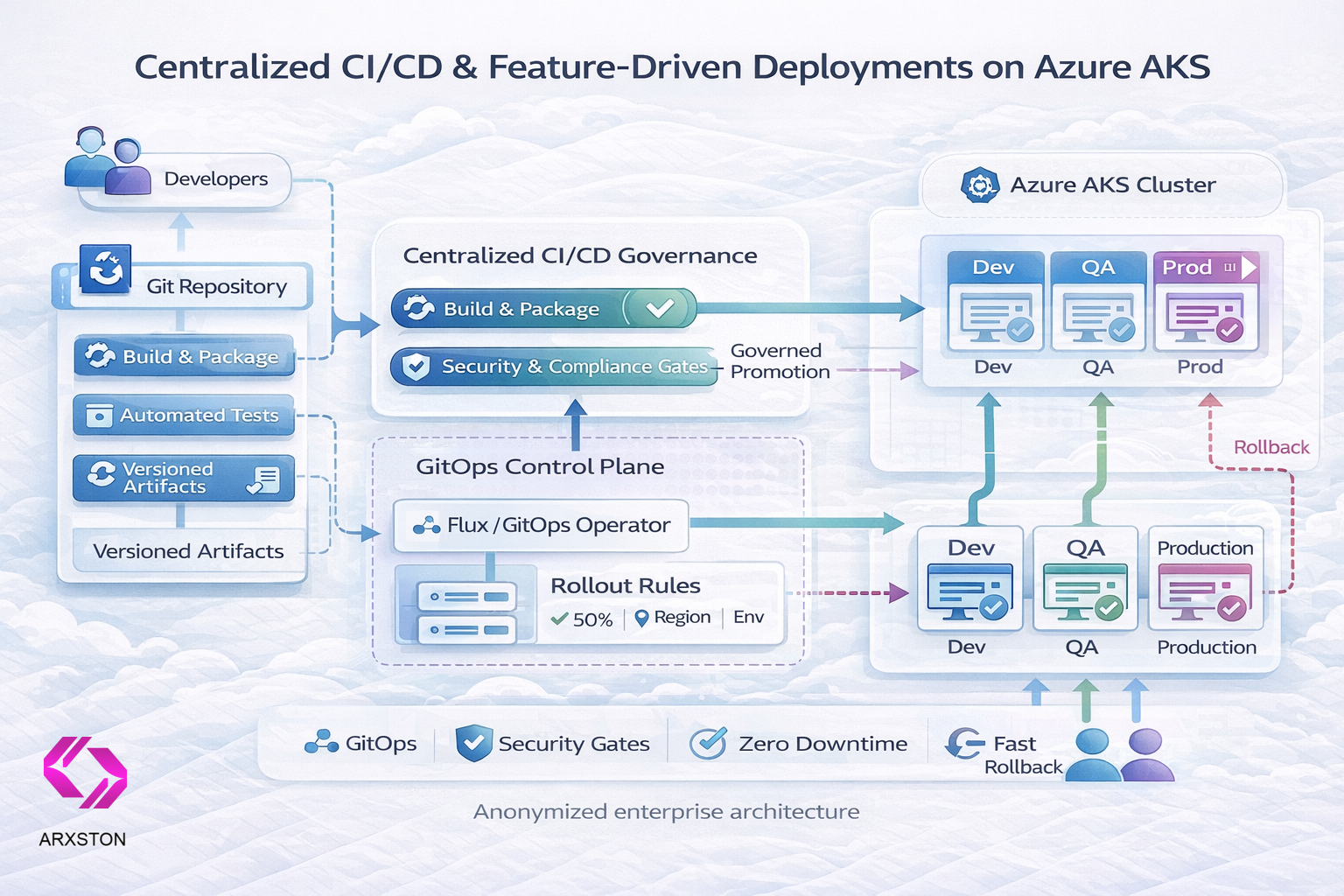
Feature flags governed service exposure, while GitOps workflows ensured traceability, consistency, and rapid rollback across Dev, QA, and Production environments.
High-level, anonymized Azure AKS deployment architecture.
Measurable Impact
Transformation Journey
Assessment
Evaluated deployment risk, pipeline gaps, and operational constraints.
Design
Defined an Azure-native, GitOps-based delivery model.
Implementation
Migrated services and centralized deployment pipelines.
Stabilization
Reduced release risk and enabled zero-downtime deployments.
Technology Stack
Azure AKS
Kubernetes orchestration layer.
Azure Pipelines
Centralized pipeline orchestration.
Flux
GitOps-based deployment management.
ConfD
Dynamic configuration management.
Feature Flags
Controlled rollout and rollback.
ARM Templates
Infrastructure provisioning.
Conclusion
Unifying CI/CD and enforcing feature-driven releases on Azure AKS transformed deployments from high-risk events into controlled, repeatable operations. The platform now supports enterprise-scale change with predictable behavior and minimal operational disruption.
Related Capability
Product Engineering & Platform Delivery
This engagement was delivered as part of Arxston’s Product Engineering practice — combining platform architecture, CI/CD standardization, and controlled release management to support enterprise-scale systems.
Partner with Arxston to modernize, automate, and scale with confidence.
Let's help you modernize, automate, and scale with precision.
Book a Strategy Call