Enterprise Case Study
Embedding Performance Engineering into AWS CI/CD
How Arxston embedded performance validation directly into delivery pipelines to reduce release risk and eliminate avoidable infrastructure cost.
Client identity anonymized due to enterprise confidentiality obligations.
Client Context & Core Challenges
Client Context
The client operated a globally distributed enterprise platform supporting mission-critical workloads across multiple business units.
As the delivery ecosystem evolved organically—new services, teams, and tooling layered onto an aging release model—feature velocity increased, while confidence in performance and scalability steadily eroded.
Core Challenges
- Performance validation lagged behind accelerating release velocity
- Testing occurred late in the delivery lifecycle, increasing release risk
- Static, manually provisioned environments inflated cloud spend
- Leadership lacked decision-grade signals on production readiness
Why This Problem Mattered
Performance validation had become detached from the delivery system itself. As release frequency increased, confidence in production behavior decreased.
This created a systemic risk: releases were technically complete, but operationally uncertain. Teams compensated by delaying deployments, over-provisioning infrastructure, or accepting elevated risk during peak traffic.
“Performance results existed — but they were not actionable at release time.”
Engineering Approach
Performance engineering treated as an architectural control, not a downstream activity.
1. Performance as Architecture
Performance engineering was embedded directly into the delivery architecture rather than treated as a downstream testing phase.
2. CI/CD-Native Performance Validation
Performance checks executed automatically within AWS CI/CD pipelines after successful builds and functional validation.
3. Ephemeral Infrastructure by Design
Static test environments were eliminated. Infrastructure existed only for the duration of execution.
4. Decision-Grade Observability
Metrics were correlated with system behavior to inform release readiness, not merely populate dashboards.
Before → After
How the delivery model changed once performance became architectural.
Before
Performance as a Downstream Activity
- • Performance validation decoupled from CI/CD
- • Static or manually managed test environments
- • Release approval based on incomplete signals
- • Infrastructure cost optimized reactively
After
Performance as a Delivery Control
- • Performance gates embedded in CI/CD pipelines
- • Ephemeral, pipeline-scoped execution environments
- • Release readiness driven by observed system behavior
- • Infrastructure spend aligned to execution demand
CI/CD-Integrated Performance Architecture
A delivery architecture embedding performance validation directly into CI/CD pipelines to evaluate release candidates under production-like conditions.
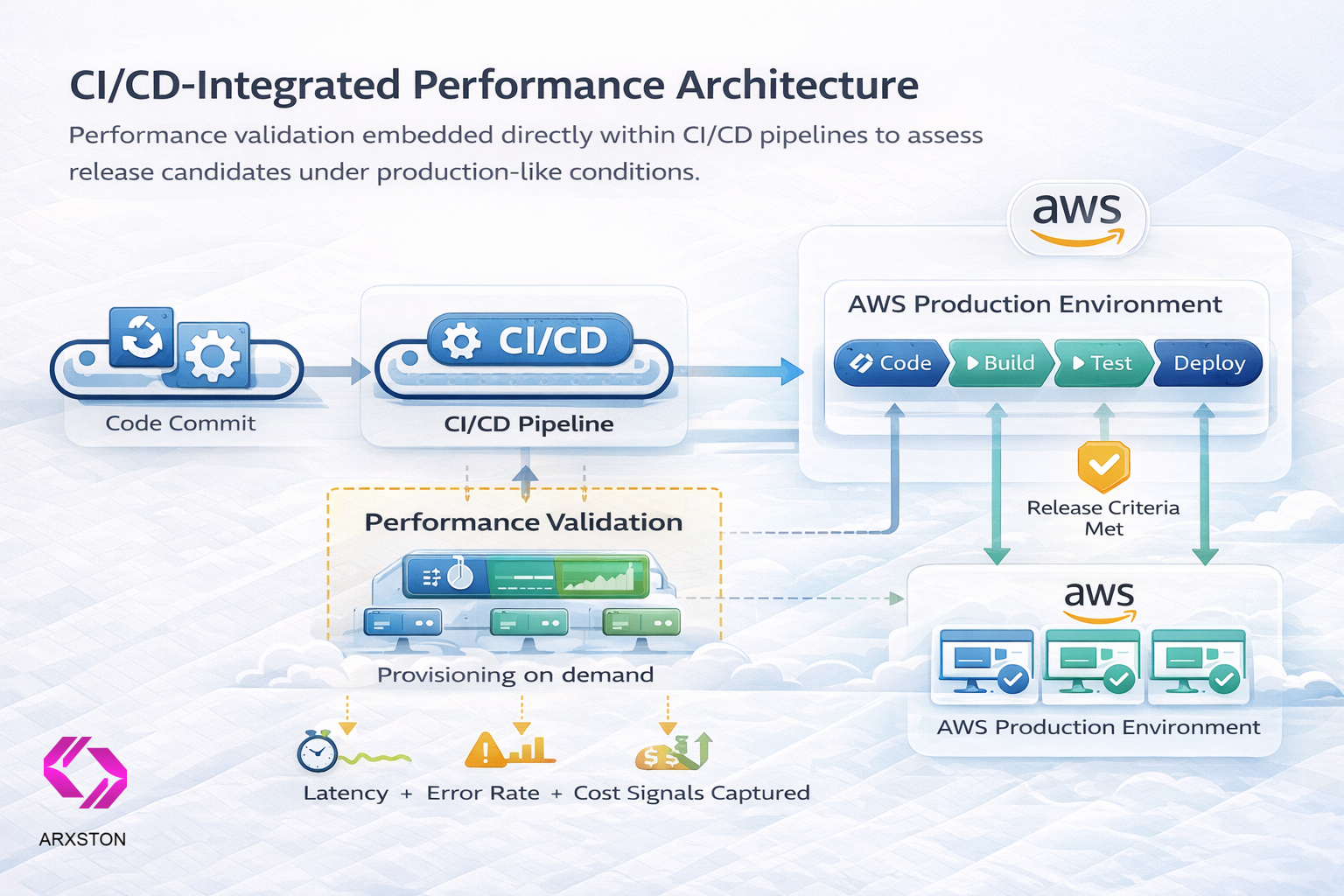
Performance tests executed automatically during pipeline runs, provisioning ephemeral infrastructure on demand and capturing latency, error rates, and cost signals before promotion.
High-level, anonymized architecture illustrating CI/CD-native performance execution.
Measurable Impact
Transformation Journey
Assessment
Identified performance bottlenecks, cost inefficiencies, and release risk.
Architecture Design
Defined CI/CD-native performance execution models.
Automation
Implemented ephemeral infrastructure and pipeline integration.
Stabilization
Reduced release risk, optimized cost, and enabled internal teams.
Technology Stack
AWS
Cloud infrastructure and managed services.
CI/CD Pipelines
Automated build, test, and release orchestration.
GitHub
Source control and pipeline triggers.
JMeter
Distributed performance testing.
Datadog
Metrics, traces, and observability.
Infrastructure Automation
Ephemeral environment provisioning.
Related Capability
Cloud Architecture & Enterprise Modernization
This outcome was enabled through Arxston’s cloud architecture and modernization practice — designing delivery systems where performance, cost efficiency, and release confidence are treated as architectural concerns rather than downstream checks.
Conclusion
Embedding performance engineering directly into AWS CI/CD pipelines shifted performance validation from a downstream activity into a core delivery control. The result was a delivery system capable of scaling with confidence, cost discipline, and operational predictability.
Partner with Arxston to modernize, automate, and scale with confidence.
Let's help you modernize, automate, and scale with precision.
Book a Strategy Call