Enterprise Case Study
Standardizing CI/CD at Scale Across 300+ Microservices
How Arxston replaced fragmented Jenkins pipelines with a standardized, secure AWS-native CI/CD platform capable of supporting hundreds of independently deployed services.
Client identity anonymized due to enterprise confidentiality obligations.
Client Context & Challenges
Client Context
The client operated a large-scale microservices architecture with over 300 independently deployed services supporting business-critical systems.
CI/CD pipelines evolved organically on Jenkins, resulting in fragmented pipelines, inconsistent delivery standards, and growing operational risk during releases.
Core Challenges
- Manual and inconsistent pipeline configurations
- Pipeline architecture unable to scale consistently across hundreds of services
- Weak security and compliance enforcement
- Slow onboarding and high cognitive load for developers
Why This Problem Mattered
As service count increased, CI/CD became a bottleneck rather than an enabler. Pipeline changes were slow, error-prone, and difficult to audit across teams.
This introduced systemic risk: inconsistent release behavior, uneven security enforcement, and growing friction between platform teams and service owners.
“The delivery platform itself was becoming a constraint on scale.”
Engineering Approach
From fragile pipelines to a standardized DevOps platform.
1. Pipeline Standardization
A template-driven CI/CD model was introduced to enforce consistent delivery behavior across services, with infrastructure and pipelines defined as code.
2. Configuration-Driven Customization
JSON-based interfaces enabled teams to customize pipelines without duplicating or modifying shared logic.
3. Automated, Event-Driven Execution
Pipelines executed automatically on code merge, ensuring fast, repeatable, and synchronized deployments.
4. Security as a Non-Negotiable Control
Security scanning, secrets management, and access controls were enforced as mandatory stages in every pipeline.
Standardized AWS CI/CD Platform Architecture
A centralized CI/CD platform replacing fragmented Jenkins pipelines with AWS-native workflows designed for scale, auditability, and controlled change.
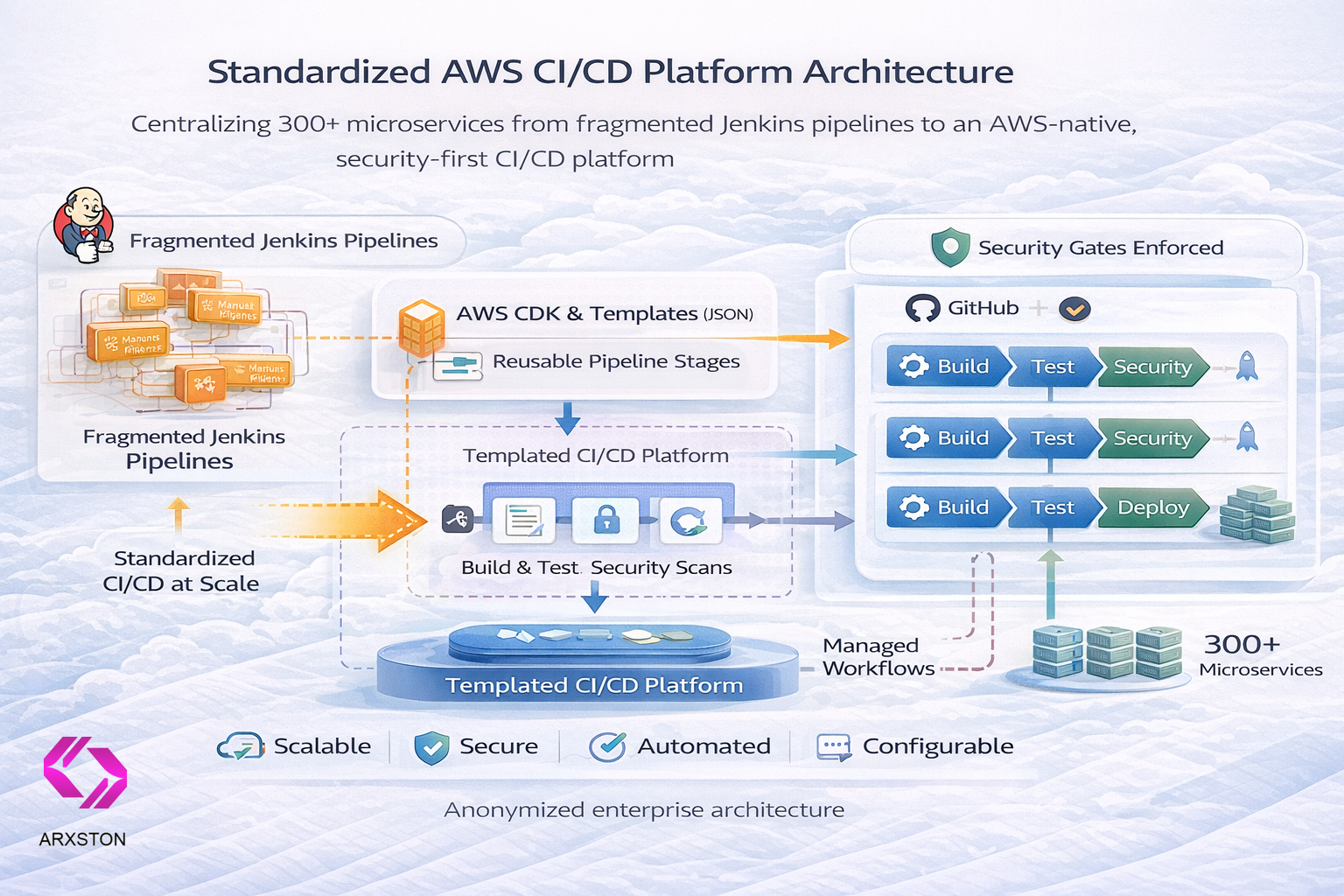
CDK-based templates enforced consistency across services, while JSON configuration enabled service-level flexibility without increasing long-term maintenance overhead.
High-level, anonymized architecture illustrating the Jenkins to AWS CI/CD migration.
Measurable Impact
Transformation Journey
Assessment
Identified pipeline inconsistencies, scalability limits, and operational risk.
Design
Defined a CDK-based, template-driven CI/CD architecture.
Migration
Gradually migrated 300+ services from Jenkins to AWS CI/CD.
Optimization
Strengthened security controls and reduced cognitive load for engineering teams.
Technology Stack
AWS CI/CD
Managed CI/CD services.
AWS CDK
Infrastructure and pipeline templating.
GitHub
Source control and pipeline triggers.
CodeQL
Static security analysis.
SonarQube
Code quality enforcement.
Datadog
Monitoring and observability.
Conclusion
Replacing fragmented Jenkins pipelines with a standardized AWS-native CI/CD platform transformed delivery from a collection of bespoke workflows into a governed, scalable system. The result was predictable delivery, enforced controls, and a platform capable of supporting continued service growth.
Related Capability
DevOps, SRE & Reliability Engineering
This transformation was delivered as part of Arxston’s DevOps and reliability engineering practice — standardizing CI/CD, enforcing security and quality gates, and enabling scalable, predictable delivery across hundreds of independently deployed services.
Partner with Arxston to modernize, automate, and scale with confidence.
Let's help you modernize, automate, and scale with precision.
Book a Strategy Call